
TL; DR:
This blog is targeted at B2B founders, CMOs, marketing heads, and performance marketers who want to use LinkedIn Document Ads for ebook, report, whitepaper, guide, and playbook-based lead generation.
- LinkedIn Document Ads help B2B brands promote long-form content directly inside the LinkedIn feed, allowing users to preview or download documents without leaving the platform.
- The format works well for B2B lead generation because it combines content marketing with paid distribution, helping brands educate prospects, build trust, and capture leads through LinkedIn Lead Gen Forms.
- Strong performance depends on asset quality, targeting, copy, and follow-up. A useful report or ebook, precise ICP targeting, clear ad messaging, short forms, CRM sync, nurturing, and retargeting are essential.
- The blog positions Ad Momenta as a LinkedIn advertising and lead-generation partner that connects positioning, branding, content, campaign execution, and conversion strategy to generate higher-quality B2B leads.
Introduction
B2B buyers don’t always opt in to an ad the first time they see it. To give them a reason to trust the brand, they need education, proof, and category context before they provide information and schedule a call.
That’s why ebooks, reports, whitepapers, checklists, and guides continue to be relevant in B2B marketing. The problem is distribution. It’s a very powerful asset if it doesn’t get to the right decision-makers.
However, LinkedIn Document Ads allow brands to promote documents directly within the LinkedIn feed, alleviating this issue. When used with proper targeting, messaging, and follow-up, it can become a powerful B2B lead-generation tool for valuable content.
Direct Answer
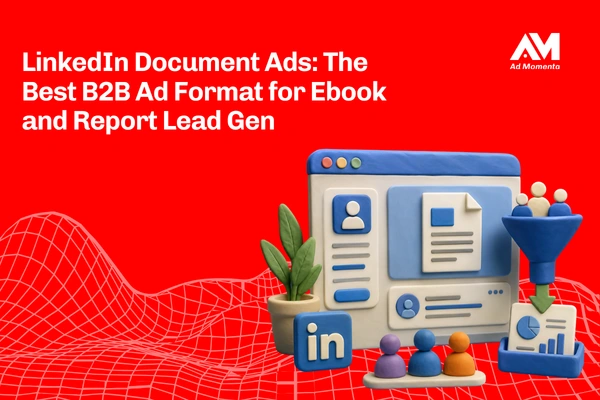
A B2B advertising format, LinkedIn Document Ads feature a downloadable or previewable document like an ebook, report, guide, whitepaper, case study, presentation, or more, directly in the LinkedIn feed. They are great for generating leads from ebooks and reports, as people can interact with the content without ever leaving LinkedIn. Brands can share the document publicly or place it behind a LinkedIn Lead Gen Form to collect lead information. For B2B marketers, it can be helpful to educate prospects, build trust, and secure high-intent leads.
What are LinkedIn Document Ads?
As a Sponsored Content format, LinkedIn Document Ads enable advertisers to send their documents directly to the LinkedIn feed and LinkedIn Audience Network. According to LinkedIn, the format is suitable for ebooks, case studies, whitepapers, infographics, and presentations.
Put simply, they enable brands to transform long-form content into an interactive ad experience. This document is not pushed to an external landing page as usual; instead, it is displayed in the feed, where prospects can “preview” or “read” the content.
The format may be used by advertisers for Brand Awareness, Engagement, and Lead Generation goals, and can be provided without restrictions or restricted by a Lead Gen Form.
Why LinkedIn Document Ads Matter for Modern Businesses
In the B2B space, today’s buyers expect helpful content before sales content. They are researching issues, comparing solutions, aligning, and looking for credible vendors.
LinkedIn Document Ads are important because they combine content marketing and paid distribution. A brand can use a useful report, ebook, or industry guide and put it in the hands of the right people based on their job title, function, industry, seniority, company size, geography, or account lists.
This helps with:
- Reaching the appropriate buying committee
- Content-based lead generation: Lead generation from valuable gated content.
- Build trust with your brand by providing educational materials.
- Content retargeting is an excellent way to retarget. Content retargeting is another great form of retargeting.
- Improved content and performance marketing alignment
B2B brands can use the format most effectively if the document offers something of value in return for the prospects’ information.
How LinkedIn Document Ads Work
It all begins with the asset. It might be an ebook, a report, a checklist, a benchmark study, a playbook, a guide, or a presentation. The asset needs to solve a problem the buyer has, not be a brochure.
Then, the campaign is developed within LinkedIn Campaign Manager. Document Ads can be deployed on LinkedIn with awareness, engagement & lead generation goals. In this case, if the objective is to capture leads, brands can add a Lead Gen Form to the document.
According to LinkedIn, once a Lead Gen Form is added, members won’t be able to view or download the complete document until they click to unlock it and fill out the form. Advertisers may select the number of pages to see as a preview.
- A real workflow would involve the following:
- Select the campaign goal.
- Upload the document.
- Determine whether the asset is gated vs. ungated.
- Define the audience.
- Create the text for the advertisement and headline.
- Make or import a Lead Gen Form.
- Start, test, and fine-tune.
- Integrate sales leads with CRM/marketing software.
- Send follow-up email, remarketing, or sales outreach.
Key Benefits of LinkedIn Document Ads
- Lower friction for content consumption: Users can preview the asset on LinkedIn, reducing the effort required to engage.
- Better B2B targeting: Brands can distribute reports and ebooks to specific professional audiences rather than relying solely on website traffic or organic reach.
- Useful lead capture: When paired with Lead Gen Forms, the format can collect prospect details while keeping the experience native to LinkedIn.
- Stronger thought leadership: Reports, insights, playbooks, and industry guides help brands demonstrate expertise before asking for a meeting.
- Improved nurture opportunities: Leads from content assets can be segmented by topic, pain point, job role, and campaign interest.
- Better creative testing: Brands can test different document titles, cover designs, preview pages, hooks, and audience segments.
Common Mistakes Businesses Make with LinkedIn Document Ads
- Using weak assets: A generic company brochure will not perform like a useful report, checklist, or guide. The content must solve a real problem.
- Gating too early: If the preview pages do not create enough value, users may not complete the Lead Gen Form.
- Targeting too broadly: Broad targeting increases waste. B2B campaigns should focus on role, seniority, industry, company size, and buying relevance.
- Writing vague ad copy: Copy like “Download our report” is not enough. The ad should clearly explain what the reader will learn and why it matters.
- Asking too many form questions: Long forms can reduce completion rates. Ask for the information required to qualify and follow up effectively.
- Not planning nurture: A content lead is usually not sales-ready immediately. Without email nurture, retargeting, or sales context, the lead may go cold.
- Measuring only cost per lead: A low CPL is not enough. B2B teams should also check lead quality, job titles, company fit, meeting rate, and pipeline impact.
Best Practices to Get Better Results from LinkedIn Document Ads
With a solid content offer, begin. The most successful are typically those that solve a clear, relevant question for the audience. These can range from “2026 B2B Demand Generation Benchmarks” to “The Founder’s Guide to Reducing CAC” or “A CMO Playbook for Pipeline Quality.
Show some value on the first few pages. Because the user can see some pages before unlocking, the first few pages should have a compelling opening, a helpful nugget of information, and a compelling desire to turn the page.
Target specific segments of your audience. The messaging in a CFO-based report shouldn’t be the same as a CMO-based report. Target an asset, headline, and targeting to the buyer’s context.
Transcribe the same asset using Google and AI search engines to create SEO content. For instance, a LinkedIn report can be published as a blog post, a landing page, an FAQ page, a comparison page, or a series of LinkedIn posts. This will enable search engines and AI systems to better understand your topical expertise.
Most importantly, tie the campaign to conversion. Sync leads to the CRM, set up lead-scoring criteria, design follow-up emails, and build retargeting audiences based on engagement.
LinkedIn Document Ads Strategy for B2B Brands
While this format is similar to generic lead generation, the approach B2B brands should take to it is different. Download of documents is not the goal. It’s the beginning of a purchasing dialogue.
The strategy should entail:
- A clearly defined ICP and campaign goal.
- A robust learning resource
- An intuitive landing page or thank-you page for the next steps
- Sales-aligned lead qualification
- CRM tracking
- Nurture sequences
- Retargeting campaigns
- Evaluation based on pipeline quality
Its format is particularly suitable for SaaS businesses, consulting businesses, education brands, healthcare B2B businesses, agencies, HR solution providers, fintech brands, and enterprise service providers.
The brand may not want to invite cold viewers to book a call right away, but it can instead give them valuable information. This establishes trust, improves recall, and helps the sales team follow up with warm sentiment.
Why Choose Ad Momenta for LinkedIn Advertising and Lead Generation
Ad Momenta helps B2B brands leverage performance campaigns as a component of a growth system, rather than as a standalone media campaign.
The team works with brands to break down the positioning into something simpler that prospects can easily comprehend: what the business does, who it serves, and why it’s important. This is crucial since even the most effective campaign can’t undo poor messaging.
Ad Momenta also assists with creating differentiated branding so that your reports, ebooks, ads, and landing pages appear credible, consistent, and memorable.
The content team develops assets that click, based on the buyer’s pain point, search intent, market context, and conversion goals. This improves lead magnets’ usefulness and their ability to attract the right audience.
Ad Momenta’s performance campaigns focus on conversion through targeting, creative, copy, landing page, forms, and follow-up journeys. It’s not about more leads. The emphasis is on improved lead generation and enhanced conversion quality.
Ad Momenta links positioning, branding, content, and marketing to help B2B brands build momentum throughout the entire funnel.
Final Thoughts
A key reason why LinkedIn Document Ads are effective is that they engage B2B buyers when they are in research mode. They help brands inform, establish trust, and gain prospects’ interest without requiring them to enter sales discussions right away.
The format, however, only works if the asset is useful, the targeting is precise, the copy is clear, and the follow-up is planned.
This is where the value for B2B founders, CMOs, and marketing leaders lies. Ad Momenta can turn your expertise into qualified demand if your brand lacks distribution, but has strong expertise.