
TL; DR:
The blog targets enterprise marketing leaders, global demand generation teams, PPC managers, CMOs, and B2B brands looking to scale paid campaigns across multiple countries, platforms, languages, and business units.
- The right PPC agency must combine strategy with global execution: It should manage localisation, platform expertise, governance, compliance, budget allocation, creative testing, CRM integration, and coordination with internal and regional teams.
- Global campaigns require both central control and local flexibility: Brands need shared tracking, reporting, naming conventions, and brand standards while adapting keywords, offers, messaging, bids, and landing pages to each market.
- Campaigns should optimise for qualified pipeline, not cheap leads: Performance must be evaluated through sales acceptance, opportunities, pipeline contribution, revenue influence, and lead quality rather than clicks, form submissions, or low CPL alone.
- Tracking and landing pages must be fixed before scaling: Reliable conversion tracking, CRM feedback, clear lead definitions, market-specific messaging, strong proof, focused landing pages, and low-friction forms are essential to prevent increased budgets from scaling waste.
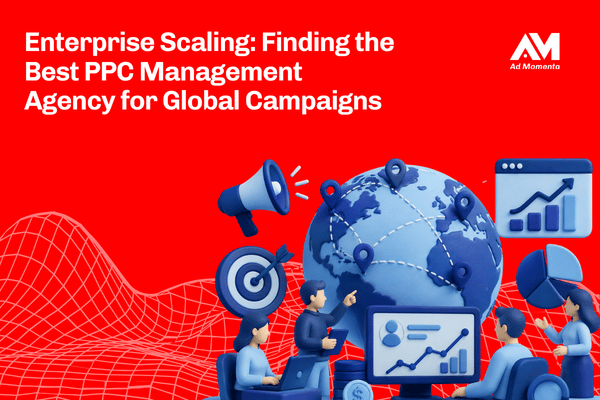
Scaling across countries isn’t as easy as just scaling budgets. Managing multiple audiences, multiple languages, multiple platforms, multiple regulations, multiple sales cycles, and multiple reporting systems without losing control is the game enterprise brands have to play. The right ppc management agency provides the strategy and consistency that can defeat the complexity. This guide outlines some of the things you need to consider, the fundamentals of global PPC, and how to find a partner that will enhance any pipeline.
Direct Answer: How Do You Find the Best PPC Partner for Global Campaigns?
Global campaigns are best managed by a good ppc management agency that blends strategic planning with platform proficiency, meets local market expectations, can precisely measure performance, and has good governance. It should focus on reporting and fine-tune country, language, audience, offer, and sales cycle. Enterprise teams should evaluate their experience of budget allocation, conversion tracking, integration with the CRM system, creative testing, localisation, compliance, and coordination with internal teams. Most of all, the agency needs to prioritise towards qualified pipeline and revenue, rather than towards clicks or form submissions. The right partner is an extension of the marketing team and aids in decisions across markets.
What Is a PPC Management Agency?
A ppc management agency designs, executes, tracks, and optimizes paid marketing campaigns on platforms like Google Ads, Microsoft Ads, LinkedIn, Meta, YouTube, and programmatic advertising.
In enterprise businesses, it is more than just keyword bidding. The agency can handle several accounts, countries, currencies, business units, audiences, landing pages, and reporting systems. It establishes a unified approach and gives local teams the flexibility to tailor the messaging and offers.
Why PPC Management Matters for Modern Businesses
Paid media can capture high-intent demand, support launches, enter new markets, and keep a brand visible throughout the buying journey. Poor management, however, can scale waste as quickly as it scales reach.
Effective enterprise PPC supports:
- Growth: Controlled testing helps brands enter new regions and segments.
- Visibility: Search, social, and video ads build presence across the funnel.
- Lead generation: Better targeting reaches relevant decision-makers.
- Conversions: Stronger offers and landing pages reduce friction.
- Brand trust: Consistent messaging improves credibility across markets.
- Long-term performance: Reliable data reveals where future investment should go.
How a PPC Management Agency Works
Typically, enterprise campaign management has 6 steps:
- Business discovery: Identify revenue objectives, priority markets, product, margins, target accounts and sales cycles.
- Review campaign structure, conversion actions, CRM integration, consent settings, audiences, and landing pages.
- Global strategy: Set up mutual objectives, management, monitoring, innovative standards and budget principles.
- Local planning: Customize keywords, language, offers, bids, and messages to each market.
- Testing and optimisation: Enhance search terms, audiences, creatives, placement, device, and conversion paths.
Connect spend to lead quality, opportunities, pipeline and next actions.
This enables central teams to have control, but not stop local teams from responding to local demand.
Key Benefits of a PPC Management Agency
- More efficient budget allocation: spend can flow towards markets, platforms and campaigns that generate better pipeline.
- More control: Naming rules, permissions, approvals, and brand standards help to minimize errors.
- Local relevance: Keywords, offers, and messages can be tailored without the need to re-create the whole programme.
- Creative and audience tests are easier to compare: Shared frameworks enable faster testing.
- Improved lead quality: Platforms can be optimised in favour of sales-ready leads.
- Consistent tracking: It allows market comparisons and investment decisions to be more easily made.
Common Mistakes Businesses Make with PPC Management
1. Scaling Before Fixing Tracking
The more you spend, the more waste you’ll have with unreliable conversion data. Firstly, validate events, CRM stages, and qualified lead definitions.
2. Using One Message Everywhere
Translation does not equal localisation. Each market has its own set of pain points, terms, competition, regulations, and purchasing habits.
3. Optimising for Cheap Leads
Cheap lead costs can mask a bad pipeline. Monitor revenue contribution, opportunities and sales acceptance.
4. Overcomplicating Account Structure
Platform learning is stifled, and enterprise governance is complex with too much fragmentation.
5. Ignoring Landing Pages
Poor positioning, poor proof, slow pages, and high-friction forms cannot be fixed with strong targeting.
6. Separating Media from Sales Feedback
Campaigns can be optimised for conversions without the input of CRM and sales, which can lead to conversions that aren’t of commercial value.
7. Choosing Only on Platform Credentials
While certifications are important, strategy, creativity, communication and cross-functional coordination are also key to enterprise success.
Best Practices to Get Better Results from PPC Management
Set a goal for each campaign. There are different metrics needed for awareness, demand capture, account engagement, and demo generation.
Integrate the advertising platforms to CRM stages. Please import qualified leads, opportunities, and revenue data so bidding systems can learn from meaningful results.
Develop a playbook for a global campaign including elements of account structure, names, tracking, localisation, testing, brand rules and reporting. Allow regional teams to be flexible to local demand.
Look at search terms, ad performance and audience questions to refine website content. Such insights can enhance SEO and AI search optimization efforts, as they can uncover how customers articulate their issues and evaluate solutions.
Last but not least, create landing pages with a single intent. To present the problem, solution, proof, market relevance, and next step in an unobtrusive manner.
PPC Management Agency Strategy for B2B Brands
B2B campaigns require a different model as they have smaller audiences, longer sales cycles, and multiple stakeholders involved in each sale.
The B2B ppc management agency should create a campaign that is aligned with stages of problem awareness, solution research, vendor comparison, and sales engagement. Active demand can be targeted with search ads, priority roles and accounts can be reached with LinkedIn, and remarketing can help with longer consideration periods.
The marketing and sales teams need to have a clear definition of what constitutes a qualified lead, as well as an agreed-upon follow-up process and a CRM feedback system. The metrics for performance should be based on account engagement, sales acceptance, opportunity creation, pipeline velocity, and revenue influence. Performance should not be measured based on metrics on a platform.
Why Choose Ad Momenta for PPC Management?
Ad Momenta considers paid media one of many elements of a growth system, rather than a stand-alone channel. Emphasis is on the relationship between positioning, branding, content, performance marketing, and conversion.
Ad Momenta helps brands:
- Make complex positioning simpler for buyers to understand so they can see its value in a hurry.
- Create multi-branding with enhanced recall.
- Increase engagement by creating content that resonates with the needs of real customers.
- Execute search, social, and remarketing performance campaigns.
- Enhance the quality of leads and conversions with targeting, offers, landing pages, and measurement.
- Build momentum through positioning, branding, and marketing unification.
This holistic solution enables B2B businesses to tie campaign decisions to the website, sales process, creative system, and overall demand generation.
Final Thoughts
Selecting the right ppc management agency is not just a media buying choice; it is an enterprise growth selection. The right partner should enable the governance, measurement, and localisation of global campaigns with ease, as well as the connection between spend and qualified pipeline.
Begin with an audit of account structure, account tracking, lead quality, landing pages, and market-level performance. Ad Momenta can assist in determining the areas of limitation and create a better integrated pathway for scaling up global campaigns.