
TL; DR:
The blog targets B2B business owners, CMOs, marketing heads, SEO managers, growth leaders, and decision-makers who are evaluating AI SEO agencies versus traditional SEO agencies to improve search visibility and lead generation.
- AI SEO vs Traditional SEO: Explains the key differences between traditional SEO and AI SEO, highlighting how AI SEO expands brand visibility across Google AI Overviews, ChatGPT, and other AI-powered search platforms while maintaining traditional SEO foundations.
- Understanding AI SEO Benefits: Highlights the importance of broader search visibility, stronger topical authority, credible content, consistent brand positioning, and improved buyer engagement throughout the B2B purchasing journey.
- Choosing the Right SEO Agency: Covers essential evaluation factors, including technical SEO expertise, content strategy, AI citation tracking, brand mentions, reporting transparency, and conversion optimisation capabilities.
- Driving B2B Growth Through Integrated SEO: Explains how combining traditional SEO, AI search optimisation, content marketing, and conversion strategies can help businesses attract qualified leads, strengthen brand credibility, and support measurable business growth.
Google’s AI Overviews, ChatGPT, and other AI-driven search experiences are becoming a preferred tool for B2B buyers to investigate solutions and shop around for vendors. For marketing leaders, the question arises: is a traditional SEO agency sufficient, or should they look for an agency with an AI edge?
The difference between an AI SEO agency and a traditional SEO agency is not merely a matter of being more up to date with technology. It’s about comprehending what capabilities enhance search presence, brand credibility, and quality lead generation.
This guide provides details on the distinctions, criteria, and considerations for choosing the correct search partner.
AI SEO Agency vs Traditional SEO Agency: What’s the Difference?
An AI SEO agency can help improve discoverability on traditional search engines and AI-powered search experiences. It utilizes technical SEO, content strategy, topical authority, brand consistency, and AI search visibility measurement.
The typical SEO agency tends to concentrate on improving organic rankings, web traffic, technical optimisation, content relevance, and link authority.
The difference is that the range of visibility being measured and optimised is what it’s all about.
But AI search optimisation isn’t a replacement for traditional SEO. Good technical underpinnings and valuable content continue to be vital.
In the B2B landscape, the best partner is the one who aligns search visibility with buyer research, qualified leads, and business growth, not just rankings and AI mentions.
What Is an AI SEO Agency?
An AI SEO agency is a digital marketing partner that works to increase the visibility of a brand’s knowledge, services, and content on search engines and AI-powered research platforms.
It’s usually done in conjunction with traditional SEO, Generative Engine Optimization (GEO), and Answer Engine Optimization (AEO).
The practices are centered on enhancing the clarity of the content, technical accessibility, expertise within a subject area, and quality of the information shared about a brand.
An AI-heavy agency can also track the frequency with which a business is cited in AI-generated responses, which businesses are cited, and if key customer questions are answered correctly.
Google says current recommendations for SEO continue to apply to its generative AI search capabilities. AI Overviews do not require any specific technical requirements, and there are no special types of schema that ensure that it appears.
In this way, the value of AI SEO lies not in taking the place of traditional SEO practices, but in supplementing the successful search strategy.
Why the AI SEO Agency vs SEO Agency Comparison Matters for Modern Businesses
For B2B businesses, the visibility of search has a larger impact on traffic than it does on website traffic.
Purchasing teams find out about industry issues, compare vendors, consider experience, and narrow their list of prospective partners before reaching out to sales teams.
Now, some of this research occurs in the context of generated answers.
A company can show up for relevant terms, but when customers ask for help with the solution, implementation, or choosing a vendor, the company is found at the bottom of their search results.
Knowing the difference between an AI SEO agency and an SEO agency enables marketing teams to assess if their strategy encompasses the entire buyer journey.
It also pushes businesses to quantify the visibility of their brand, the credibility of their content, and commercial results simultaneously.
That’s not just about getting into more search results. It’s about being a viable, trusted alternative for buyers when deciding on solutions.
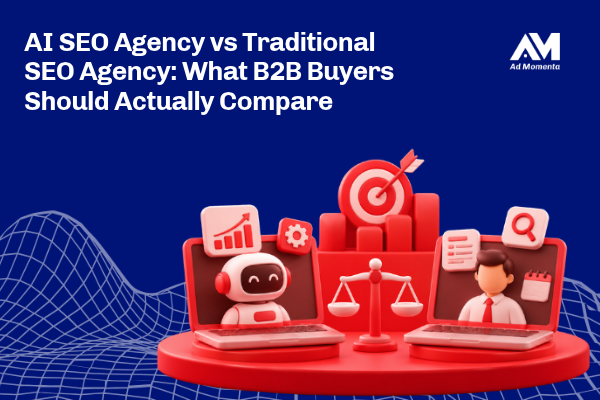
How AI SEO Agency vs SEO Agency Approaches Work
While both methods have common technical and content elements, there are some differences in priorities.
| Evaluation area | Traditional SEO agency | AI SEO agency |
| Primary focus | Organic search performance | Organic and AI-driven discoverability |
| Content strategy | Keywords and search intent | Topical depth, buyer questions, and keywords |
| Technical SEO | Crawling, indexing, performance | Same foundations, but with AI visibility factors to ponder. |
| Authority building | Not all links are relevant, and some may be dubious. | Links, expert evidence and credible brand references |
| Measurement | Rankings, traffic, conversions | AI citations and mentions are added to SEO metrics.AI citations and mentions are added to SEO metrics. |
| Business alignment | Organic lead generation | Identify how to improve search visibility throughout the B2B funnel |
Both of these strategies do not guarantee improved outcomes. The value of an agency partnership lies in execution quality, market understanding, and measurement capabilities.
How an Integrated AI SEO Strategy Works
Step 1: Audit existing search performance
Check organic visibility, technical issues, content quality, critical landing pages, and conversion performance.
Step 2: Identify buyer research questions
Track informational, comparison, implementation, and vendor-selection queries throughout the purchasing process.
Step 3: Strengthen content and technical foundations
Enhance service pages, internal links, crawlability, original ideas, and structured data as appropriate.
Step 4: Evaluate AI search visibility
Check if the relevant platforms have references or mentions of the brand for representative buyer questions.
Step 5: Measure business contribution
Evaluate pipeline influence, branded demand, lead quality, and organic conversions, in addition to the AI visibility indicators.
Key Benefits of Choosing an AI SEO Agency
When evaluating the value of an AI SEO agency or SEO agency, enterprises need to take into account the possible advantages of an even more integrated strategy.
1. Broader search visibility
An integrated strategy takes into account traditional search results as well as AI-driven discovery experiences.
2. Stronger topical authority
Expert-led, comprehensive content helps to illustrate knowledge throughout all related questions from the buyers’ side and industry issues.
3. Better buyer education
Prospects have easy access to clear comparisons, definitions, and implementation guidance to enable them to make informed purchasing decisions.
4. Improved brand consistency
Clear service descriptions, positioning, and supporting evidence help to alleviate confusion on digital touchpoints.
5. More useful marketing measurement
In combination, monitoring the performance of organic and AI visibility offers a comprehensive perspective of search-driven demand generation.
These benefits will depend upon execution and are not to be construed as guaranteed ranking or citation improvements.
Common Mistakes When Comparing AI SEO Agencies and Traditional SEO Agencies
You can end up with unrealistic expectations and disjointed marketing efforts if you choose the wrong agency.
Common mistakes include:
-
If AI SEO is a replacement for SEO, don’t neglect crawlability, indexing, content quality, and technical performance, which undermine the foundation of search visibility.
-
AI mentions are believed: AI answers are different for each query, platform, and context. No agency guarantees a regular appearance.
-
Extremely narrow focus on AI visibility scores: Visibility that doesn’t appeal to buyers or have commercial impact does not add value to the business.
-
Creating general AI-produced content: Uninformative content that is repeated from other sources is not helpful.
-
Lack of brand positioning: When customers are not able to see the difference between brands, it is not as valuable.
-
Failure to execute conversion optimization: Traffic that is relevant but isn’t converted into leads because the landing page and call to action are not strong.
-
Allowing unclear reporting: Agencies should clarify the limitations of the measurement and differentiate actual and estimated visibility.
Best Practices for Choosing an AI SEO Agency
A business’s first step when comparing an AI SEO agency to an SEO agency is to get a clear understanding of their proposed strategy.
Evaluate Technical SEO Capabilities
The agency needs to have demonstrated competency in crawling, indexing, website architecture, internal linking, and structured data.
However, AI search optimisation can’t fix fundamental website issues.
Review Content Strategy and Expertise
Search for original research, illustrative case studies, expert perspectives, relevant comparisons, and service explanations.
Content should not just be a recitation of variations of the keywords but should respond to actual customer questions.
Ask How AI Visibility Is Measured
Examine agency tracking of citations, brand mentions, relevant prompts, and competitors’ visibility.
As the answers from the Artificial Intelligence system evolve, reporting should include an explanation of the sampling methods and uncertainty.
Connect Search to Commercial Outcomes
An effective agency should line up this organic discovery and lead generation, landing page conversion, CRM reporting, and qualified pipeline.
To achieve measurable business goals and sustainable search practices, this is the best approach.
AI SEO Agency vs SEO Agency: Strategy for B2B Brands
The dynamics of B2B transactions demand a search approach that takes into account intricate purchasing decisions.
A SaaS vendor, enterprise tech company, or professional services company might have to confront technical needs, integrations, implementation issues, and competitive differentiation.
Though traditional keyword-rich content can attract search demand, topic-focused content that contains buyer content will respond to more complicated questions.
When developing a B2B search strategy, it is crucial to focus on the following:
-
Problem Discovery: Discuss the challenges in the industry and its possible solutions.
-
Solution Evaluation: Create comparisons, use cases, and implementation tips.
-
Communicate knowledge, relevant evidence, and the ability to distinguish.
-
Conversion: Clear next steps and helpful consultation opportunities.
The choice between the AI SEO agency and SEO agency will come down to whether the partner can assist with this entire process.
Why Choose Ad Momenta for AI SEO and Search Strategy?
At Ad Momenta, we consider search visibility to be part of our B2B growth plan.
We assist businesses in making the most complex positioning simple, developing differentiated branding and creating content that resonates with decision-makers.
We work on SEO, AI search optimisation, content, website experience, performance marketing, and conversion optimisation.
We work on improving brand discoverability, understandability, and accessibility.
This involves creating relevant content, enhancing the foundation of search, optimizing conversion paths, and syncing marketing efforts with quality leads.
We put SEO, branding, and performance marketing together as a whole so that you can create consistent momentum for your business.
Final Thoughts
When considering the AI SEO agency vs SEO agency comparison, consider it as a shift from old to new marketing strategies, not from old to new approaches.
The importance of traditional SEO can’t be overlooked. AI search optimisation increases the number of questions a business must answer, as well as the visibility signals a business might use to measure.
The right partner knows technical SEO, buyer behaviours, content credibility, positioning and commercial outcomes – all of which are vital for B2B brands.
Interested in knowing how your brand will look in the traditional search engine and AI search engine? Discuss AI-Search Visibility Assessment with Ad Momenta.