
TL; DR:
This blog is aimed at B2B founders, CMOs, marketing heads, performance marketers, and demand generation teams that want to understand how B2B paid search should be structured differently from consumer-focused PPC campaigns.
- Explains the core difference between B2B and B2C PPC: The blog shows how B2B PPC focuses on longer sales cycles, smaller but more valuable audiences, lead qualification, account fit, pipeline, and CRM outcomes, while B2C search is generally more transaction-driven.
- Shows how B2B PPC campaigns should be structured: It covers key strategic differences such as defining the ICP before selecting keywords, separating research intent from commercial intent, building decision-focused landing pages, and tracking what happens after form submission.
- Highlights why qualified pipeline matters more than cheap leads: The blog explains that businesses should evaluate PPC using metrics such as qualified leads, sales opportunities, cost per opportunity, pipeline generated, CAC, and closed revenue, rather than relying only on CPL or traffic.
- Provides actionable best practices for improving B2B PPC performance: It recommends tighter keyword intent segmentation, dedicated landing pages, negative keyword management, CRM integration, sales feedback, and combining PPC insights with SEO and broader demand-generation activity.
Although paid search might be the same in both B2B and B2C, the buying process is not. A consumer can purchase in a few minutes; a B2B buyer can take weeks to research and can involve several stakeholders. Hence, B2B PPC services must optimise for qualified demand, pipeline, and revenue, not traffic.
Direct Answer: How Do B2B PPC Services Differ from B2C Search?
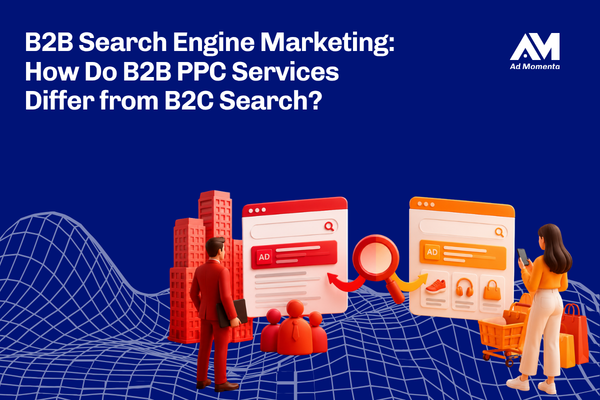
B2B PPC services differ from B2C search services because they are aimed at the business buyer who has a longer buying cycle, a smaller audience, higher deal value, and a more complex conversion path. B2C PPC tends to be about a quick buy, number of transactions, and ROI. B2B search marketing is more about high-intent keywords, lead qualification, account fit, sales opportunities, and pipeline. Success relies on the ability to link advertising information to outcomes in CRM. A campaign that generates fewer leads, but more suitable for them, is more likely to yield a higher return on investment than a campaign that generates a large volume of low-quality leads.
What Are B2B PPC Services?
B2B PPC services are paid advertising programs for business-to-business companies. These can involve Google Ads strategy, keyword research, campaign structure, ad copy, landing page optimization, conversion tracking, and remarketing.
The buyer can be a founder, procurement manager, marketing head, IT leader, or other person who forms a buying committee. Campaigns must therefore have more accurate intent targeting, more compelling qualification, and more content on their landing pages than consumer campaigns.
Why B2B PPC Matters for Modern Businesses
Search advertising speaks to a prospect when he is searching for a solution. This can be beneficial in cases of complex products and when products are organic and require time to become visible.
B2B paid search can:
- Get buyers who are already trying to solve a problem, a category, or a vendor issue
- Position and message your tests rapidly and directly
- Find search phrases that have high conversion rates.
- Create demand from scratch while SEO builds up over time
- Give content, landing page, and sales message insights
Unlike consumer segments, which require a high number of transactions, a few high-value sales opportunities in B2B can warrant a campaign.
How B2B PPC Services Work Differently from B2C Search
While the platform may be the same, the strategy may vary across key decisions.
| Area | B2B Search Marketing | B2C Search Marketing |
| Buyer | Business decision-makers | Individual consumers |
| Sales cycle | Usually weeks or months | Minutes or days later |
| Conversion | Demo, quote, consultation | Purchase, booking, signup |
| Landing page | Education, proof, qualification | Product, price, convenience |
| Core metric | Qualified pipeline | A sale or immediate ROAS |
1. Define the ICP Before Choosing Keywords
B2B keywords can attract students, job seekers, small businesses, enterprises, or researchers. Before creating a keyword list, define industry, company size, geography, use case, and decision maker.
2. Separate Research Intent from Commercial Intent
What is marketing automation? is a different buying stage from a marketing automation agency for Saas. That should be reflected in the structure, copy, bids, and landing pages of the campaign.
3. Build Landing Pages Around Business Decisions
B2B buyers need clarity and proof. Strong pages include solution, differentiation, use cases, credibility, FAQs, and next step.
4. Track What Happens After the Form
A lead isn’t the result. Integrate campaigns to CRM stages including qualified lead, opportunity, proposal, and closed revenue.
Key Benefits of B2B PPC Services
- High-intent demand capture: Connect with prospects who are in the process of researching a solution, vendor, or service.
- Improve market feedback: Discover which pain points, offers, and messages are of commercial interest.
- Trackable lead generation: Align campaigns to demos, meetings, and sales.
- More market intelligence: Search terms provide insights into buyer needs.
- Support for SEO: Paid search insights can inform the service pages, FAQs, and organic keyword priorities.
Common Mistakes Businesses Make with B2B PPC
1. Copying a B2C Campaign Structure
B2B campaigns usually need tighter intent segmentation and stronger qualification.
2. Treating Every Lead as Equal
A student downloading a guide and a procurement head requesting a proposal do not have the same value.
3. Using Generic Keywords Without Enough Control
Broad terms can attract irrelevant searches quickly. Search-term reviews and negative keywords are essential.
4. Sending Every Click to the Homepage
Paid search works better when the landing page closely matches the query and offer.
5. Optimizing Only for CPL
Low CPL can hide weak sales quality. Cost per qualified lead and cost per opportunity are more useful.
6. Ignoring Sales Feedback
Sales teams often identify poor-fit enquiries before the ad platform does.
Best Practices to Get Better Results from B2B PPC Services
Begin with business goals. Describe what is considered a qualified enquiry.
Organize keywords into groups by purpose. Different service terms, solution searches, competitor terms, problem-aware queries, and informational searches could call for various campaigns.
Create buyer-friendly and search engine optimized landing pages. Use descriptive headings and concise answers, proof, FAQs, and relevant internal links. This provides structured information that AI search engines and Google can comprehend better.
Combine paid and organic search insights. When a PPC query generates qualified buyers, beef up an SEO page for that query. There are terms to test in paid campaigns that can be identified using strong organic queries.
Most importantly, link advertising data to CRM results to optimize based on business quality and not just surface conversions.
B2B PPC Strategy for B2B Brands
Pay is a component of a demand system and should be managed as such by founders and CMOs. Begin with high-intent searches where buyers are actively looking for a vendor, platform, agency, or solution, and then design a specific landing experience for the most valuable themes.
Then finally use remarketing, LinkedIn, content, and email as appropriate to stay top of mind throughout the extended consideration period.
The reporting should be based on the following:
- Qualified leads
- Sales opportunities
- Cost per opportunity
- Pipeline generated
- Customer acquisition cost
- Closed revenue
This is also the reason why paid search should be closely aligned with positioning and content. Higher bids will not solve the problem if buyers are not aware of the difference.
Why Choose Ad Momenta for B2B PPC Services
Ad Momenta doesn’t see paid search as a traffic channel, but as part of a B2B buying process.
We’re here to take away the guesswork and create a brand that’s differentiated and content that’s aligned with what customers are truly interested in. We execute performance campaigns on commercial actions and discuss what occurs after the click – landing page, quality of leads, web strategy, and messaging in the campaign.
Ad Momenta helps brands:
- Simplify complex positioning
- Build differentiated branding
- Develop content that resonates with users.
- Create and execute performance campaigns that convert.
- Increase the quality of leads and conversions.
- Develop momentum by positioning, branding, and marketing together.
The goal is to have a more direct pathway from the buyer to a qualified pipeline.
Final Thoughts
Platforms can be the same for B2B and B2C paid search, but the growth logic is different.
B2C campaigns are frequently transaction-driven and geared towards quick revenue. There are many factors involved in B2B search that need to be taken into consideration, including limited scope of demand, multi-stakeholder decision-making, longer sales cycles, qualification, and delayed revenue.
It’s best to use B2B PPC services that are designed as a whole system of keywords, positioning, landing pages, tracking, CRM data, and sales feedback. When campaigns get clicks, but not enough qualified pipeline, Ad Momenta can help determine where the disconnect is and develop a more commercially oriented strategy.