
TL:DR;
This blog is written for B2B founders, CMOs, SEO leaders, and content strategists who want to move beyond traditional keyword targeting and build structured authority using Topic Cluster Strategy to improve both SEO and Generative Engine Optimization (GEO).
- Keywords Alone Are No Longer Enough: Ranking on platforms like Google does not guarantee visibility in AI-generated answers. AI systems evaluate topical depth, internal linking, structured knowledge, and contextual authority not just isolated keyword optimization.
- Topic Clusters Strengthen AI Citation Potential: A well-built pillar page supported by interlinked cluster articles signals consistent expertise. This structured ecosystem increases the likelihood of appearing in AI-generated summaries and conversational search results.
- Authority Is Built Through Structure, Not Volume: Owning AI answers requires clear definitions, question-based headings, logical flow, and data-backed insights. Internal linking between pillar and cluster content reinforces relationships and strengthens topical authority signals.
- Topic Clusters Are a Long-Term GEO Strategy: Topic Cluster Strategy is not a short-term ranking hack it’s a future-proof authority model. When consistently developed and updated, clusters improve organic traffic, increase AI visibility, and position a brand as a trusted source in AI-driven search environments.
Search is not only about the ranking of keywords any more. In 2026, AI applications produce answers directly, summarize the information, and suggest the brands. Unless your material is organized in the right way, you can be ranked high on the Google list and yet be missed on artificial intelligence search.
It is here that effective Topic Cluster Strategy is necessary.
A current Topic Cluster Strategy goes beyond content organization to be used in SEO. It assists your brand to gain authority, gain AI awareness, and own answers in generative search settings.
Here, in this guide, we discuss topic clusters and why they are effective with GEO (Generative Engine Optimization), why they are more effective than targeting an individual keyword, and how to apply them.
What Is a Topic Cluster Strategy?
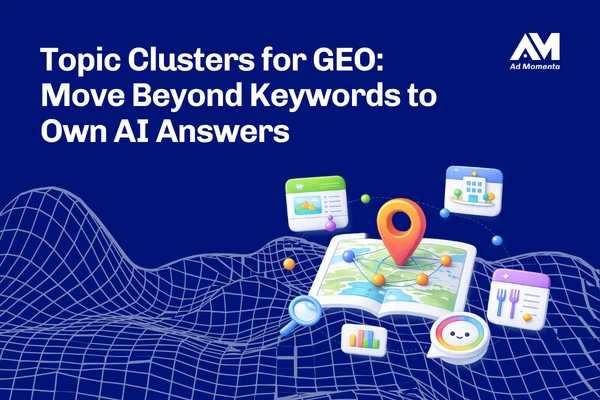
Topic Cluster Strategy A content model in which you build:
- A single pillar page on a large subject.
- Several supporting articles on similar subtopics.
- Good inter page connectivity.
You not only focus on a single target keyword, but you create a content ecosystem around a single theme.
This methodology is an indication of experience and richness to the search engine and AI.
The Reason Why Keywords Are No Longer Sufficient
Traditional SEO was usually concerned with the optimization of single pages on the search of a particular keyword.
Nonetheless, search tools driven by AI analyze:
- Context
- Topical depth
- Internal connections
- Authority in several related articles.
Having a single solid article and no supporting information in your site might not give your site the credibility required in AI citation.
Topic Cluster Strategy empowers your whole area about a subject.
The Role of Topic Clusters in Supporting GEO
Generative Engine Optimization (GEO) is dedicated to being a part of AI-generated responses.
AI systems look for:
- Clear explanations
- Consistent expertise
- Structured knowledge
- Reliable sources
When you adopt Topic Cluster Strategy you give the AI systems an excellent map of your knowledge.
The content of the pillars creates authority. Deepening is supported by cluster articles. Internal linking defines interrelationships among ideas.
Combined, this will raise your chances of appearing in AI dummies.
The Framework of an Effective Topic Cluster
In order to develop a good Topic Cluster Strategy to GEO use this framework.
Pillar Page
Your pillar page must be well prepared on the general subject matter.
It should:
- Define the topic clearly
- Cover major subtopics
- Give systematic divisions.
- Connection with further supporting articles.
To use the example, when your primary theme is Generative Engine Optimization, your pillar page needs to cover the concept of the pillar page exhaustively, then proceed to discuss other related subtopics.
Cluster Articles
Cluster articles deal with particular sub topics.
Examples might include:
- Case studies
- Strategy breakdowns
- Tool comparisons
- Advanced tactics
- Industry-specific applications
The pillar page is also supported by each cluster article which links to the pillar page.
Internal Linking Strategy
It is essential to internally link.
Each cluster page is to be linked to:
- The pillar page
- Related cluster content
This is an indication to the search engines and AI systems that your work is interlinked and detailed.
We value formal connectivity at Ad Momenta to enhance traditional ranking and AI visibility.
Giving Up Keywords to Own AI Answers
It takes beyond the coverage of keywords to own answers offered by AI.
AI applications summarize information in multiple sources. Your Topic Cluster Strategy should have:
- Clear definitions.
- Question-based headings.
- Concise explanations.
- Data-backed insights.
- Logical content flow.
The AI tools will be more inclined to mention your brand when they identify the same authority in the related materials.
Topic clusters will make you no longer rank around keywords instead of owning conversations.
Real Life Case: Topic Clusters in Action
The company that we worked with was a B2B marketing company that aims at achieving AI search visibility.
In the past, they only posted individual blog posts which were optimized against various keywords. There was inconsistency in performance.
We redesigned their site with Topic Cluster Strategy. We created:
- A comprehensive pillar page
- Several assisting cluster articles.
- Clear internal linking
- FAQ-driven content sections
It took a few months before their organic traffic had improved. More to the point, their brand started to be mentioned more often within AI-generated summaries.
The difference was the transition to organized authority as opposed to the scattered keywords.
How to Develop a Best Topic Cluster Plan at GEO
To take the Topic Cluster Strategy that would enable GEO, begin with the following.
First, you need to find a central theme that matches your business competence. This must be general enough to allow supporting more subtopics.
Second, draw out connected subtopics. Consider customer queries, industry trends, and strategic issues.
Third, develop a pillar level page that provides an introduction and linking to other content.
Fourth, report cluster articles on a regular basis. It is the depth rather than the volume.
Fifth, refresh the content as a way of remaining in authority.
Credibility is developed through consistency.
Topical Cluster Implementation Errors
Other brands come up with cluster articles but they do not connect them effectively. In the absence of internal linking, authority signals are undermined.
Other people make shallow pillar pages. A powerful pillar page is supposed to be thorough and authoritative.
The other error is to concentrate on the SEO metrics. Although the importance of traffic is significant, the point of a modern Topic Cluster Strategy is increased visibility, even the answers provided by AI.
Do not take clusters as a temporary strategy. They are long term authority policies.
The Success of a Topic Cluster Strategy Can Be Measured in a Number of Ways
Track to measure performance:
- Organic traffic growth
- Increases in visibility of the keywords.
- Time on page
- Internal link engagement
- References to the brand on AI responses.
Although AI citation search remains under development, a growing brand presence in conversational search is a good sign of successful GEO alignment.
We calculate both traffic and signals of authority at Ad Momenta to achieve long-term growth.
Why Topic Clusters Future-Proof Your Content
The search made by AI is more context-driven and conversational.
Topic clusters are a perfect fit through this shift since:
- Deliver systemized learning.
- Demonstrate topical competence.
- Question-based queries Support.
- Enforce authority indicators.
You do not go after single keywords, but create a sustainable stream of knowledge.
This secures your digital future.
Our Application of Topic Clusters at Ad Momenta
At Ad Momenta, Topic Cluster Strategy is applied, both in SEO and GEO campaigns.
Our process includes:
- Topic mapping
- Content architecture planning.
- Pillar page development
- Cluster article creation
- Strategic internal linking
- Authority monitoring
We are interested in the process of assisting brands in the process of getting out of keywords and becoming the experts in their niche.
The possession of AI responses must be organized knowledge, not random posts on blogs.
Final Thoughts
Keywords ranking will no longer suffice in 2026. The use of AI platforms is influencing the discovery and evaluation of brands by users.
Multi-High Topic Cluster Strategy assists you in escaping the realm of isolated key words and creates actual authority.
Organizing your content in pillar pages and cluster-based support makes you more visible, more credible, and more likely to be used in an AI-generated response.
In case you desire to possess AI responses, begin with organized power.
The topic clusters are not merely a tactic of search engine optimization. They form the basis of long-term digital leadership.