
TL: DR;
This blog is written for B2B marketers, founders, SaaS companies, consultants, and decision-makers who want to understand the different types of LinkedIn ads and how to use them strategically for business growth.
- Why LinkedIn Ads Work for B2B: LinkedIn’s professional targeting—based on job title, industry, company size, and seniority makes it highly effective for reaching decision-makers and generating qualified leads.
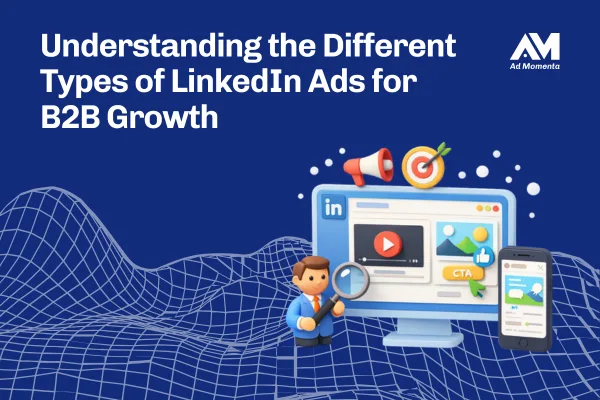
- Main LinkedIn Ad Formats Explained: The blog breaks down Sponsored Content (single image, carousel, video, document ads), Lead Gen Forms, Message Ads, Conversation Ads, Text Ads, and Dynamic Ads in simple terms.
- Choosing the Right Format for Your Goal: Each ad type serves a different objective brand awareness, lead generation, account-based marketing, or retargeting—and success depends on aligning format with the buyer journey.
- Strategy, Targeting & Optimization Matter Most: High-performing LinkedIn campaigns require precise targeting, value-driven messaging, strong creatives, and continuous testing not just selecting an ad format.
LinkedIn is now the most potent paid advertising network for B2B brands. As decision-makers, founders, marketing heads, and senior executives spend time on a single platform, that platform is automatically the best place to advertise.
Our advice: The sponsorship of LinkedIn is the most appropriate solution at Ad Momenta for B2B companies that require qualified leads, and not only traffic. Nevertheless, many businesses struggle to understand the various types of LinkedIn ads and which ones work best to meet their objectives.
Here, we discuss the primary categories of LinkedIn ads, how they work, and how we use them to drive tangible B2B growth.
Why LinkedIn Ads Work So Well for B2B
Unlike platforms that primarily target interests and behaviors, LinkedIn can be targeted using professional information. You have the option of reaching people in terms of job titles, industries, the size of the company, seniority, skills, and even the company.
Such a degree of targeting is very potent in B2B marketing. LinkedIn can get you to the CFOs of mid-sized SaaS organizations or HR Directors of manufacturing companies.
This accuracy targeting would significantly improve lead quality. The LinkedIn ad can be more expensive per click than other sites, but conversion rates are significantly higher for B2B brands.
At this point, we will examine the primary categories of LinkedIn advertisements.
Sponsored Content: The Most Popular LinkedIn Ad Format
Sponsored Content is extracted in the LinkedIn news feed. It resembles normal posts but it is indicated that it is sponsored. This format aligns with the user experience and is among the most successful LinkedIn ad formats.
Single Image Ads
The most popular form of advertisement is single-image ads. They have a single image, a headline, supporting text, and a call-to-action button.
Single image ads typically make us advertise blog articles, lead magnets, service pages or case studies. Clarity is the key to success in this. The benefit should be communicated immediately in the message. Instead of discussing your company, discuss the issue you resolve.
For example, when offering marketing services, instead of stating that we provide marketing services, a more powerful statement would be: “Having trouble finding B2B Leads?” Here’s the System We Use.”
Simple messaging works best.
Carousel Ads
Carousel ads enable you to have more than one swipeable card in a single advertisement. Each card can include an image and a message.
The format is effective for describing a process or highlighting several services. For example, in a full-funnel B2B marketing strategy, we could allocate all cards to awareness, lead generation, nurturing, and conversion.
Carousel advertisements are attractive because they drive interaction. They are especially useful for storytelling and for simplifying complex services into simple steps.
Video Ads
Video is among the most effective trust-building tools in B2B advertising. Video advertisements are automatic, and they instantly get your attention.
We suggest that LinkedIn video ads should be brief and to the point. A 30-60-second educational video may have an advantage over a very long promotional video. Decision-makers are busy. They like to get straight to the point, share industry tips, or include a brief case study.
Document Ads
Document advertisements allow users to preview and download PDFs on LinkedIn. They are great for white papers, industry reports, and detailed guides.
This format is particularly effective for lead generation, as users can preview valuable information on the site before providing their contact details. It establishes credibility and increases form completion.
For B2B companies providing high-value services, document ads can significantly drive inbound leads.
Lead Gen Form Ads: Built for Conversion
Lead Gen Forms are also one of the most effective B2B growth LinkedIn ads.
The form opens within LinkedIn instead of redirecting users to a separate landing page. It would automatically complete the user’s professional information, such as name, email, and job description. This minimizes resistance and maximizes conversions.
Sponsored Content and Lead Gen Forms are frequently used alongside webinar registrations, strategy calls, demo bookings, and gated content access.
The point here is to deliver something truly valuable. The decision-makers will not send their information to generic content. The offer should address a particular business issue.
Message Ads and Conversation Ads: Direct Engagement
Inbox-based advertising formats are also available on LinkedIn.
Message Ads are messages that are sent directly to the inbox of a LinkedIn user. This format is personal and should be handled with caution. If the message is overly promotional, it can be annoying.
Message Ads will be our first choice for inviting attendees to an event, making an exclusive offer, or conducting personal outreach during an account-based marketing campaign.
Conversation Ads do this even further by giving the user the option to choose their response in the message. It introduces a guided session, akin to a basic chatbot on LinkedIn.
For example, a mail message may state, “What most interests you?” and provide a click choice: Download Guide, Book Demo, or See Case Study.
This is a good format when you need to segment your audience and direct them to different actions.
Text Ads and Dynamic Ads: Supporting Formats
Text advertisements appear along the sides of the LinkedIn desktop. They are simpler and, in most cases, cheaper. Although they do not drive the most engagement, they can be effective for retargeting campaigns or for scaling brand awareness.
Dynamic ads, in contrast, are personalized based on the user’s profile information. There are formats that automatically insert the user’s name or profile picture. Such advertisements can be useful for increasing the number of followers on LinkedIn pages, advertising vacancies, or driving traffic to specific pages.
We tend to incorporate these formats into our campaigns to supplement Sponsored Content strategies, rather than use them independently.
How to Choose the Right Type of LinkedIn Ads
The format you use should align with your campaign goal.
Sponsored Content styles, such as single image or video ads, are the most suitable ones when you want to create brand awareness. If you are interested in lead generation, use Sponsored Content with Lead Gen Forms, or consider document ads, which are more effective.
Message Ads and Conversation Ads may be useful for account-based marketing or highly targeted outreach.
We identify the target audience’s position in the buying cycle and then use the appropriate LinkedIn ad format. This business tactic avoids budget waste and improves return on ad spend.
Best Practices for LinkedIn Advertising Success
To be successful with LinkedIn ads, it takes more than a proper choice of format.
To begin with, the targeting should be accurate. Wide targeting would cost more and reduce the lead quality. We suggest narrowing the audience using a combination of job title, industry, company size, and seniority.
Second, pay attention to value-based communications. LinkedIn users are more responsive to educational and insightful articles than to aggressive advertisements.
Third, it is the quality of creativity. Simple calls to action, clean visuals and simple headlines do make a huge difference. Elaborate copy and trash should be avoided.
Lastly, retargeting is necessary. Many B2B decisions take weeks or months. Retargeting individuals who have interacted with your ads or visited your site keeps your brand top of mind and increases conversion rates.
How Ad Momenta Helps You Scale with LinkedIn Ads
At Ad Momenta, we do not simply place advertisements. We develop comprehensive B2B growth systems for LinkedIn advertising.
We assist companies in identifying the most effective LinkedIn ad formats to achieve their objectives. Our creatives and copy are developed for high conversion, we target audiences with high accuracy, and we continuously optimize our campaigns to reduce cost per lead.
We are performance-oriented and data-driven. We experiment with various formats, analyze the results, and refine strategies to maintain growth.
When performed correctly, LinkedIn advertising can be a change maker in case your B2B company needs a better quality, stronger brand positioning, and predictable revenue growth.
Conclusion
Understanding the various categories of LinkedIn advertisements is important for every B2B brand that takes growth seriously. Sponsored Content and Lead Gen Forms are one type of ad that works well; the other is Message Ads and Dynamic Ads.
It is not only about being knowledgeable on the formats, but also about utilising them wisely, depending on your business objectives and the behaviour of your audience.
We have been helping B2B and B2C companies for the past 5 years to grow their businesses digitally. LinkedIn advertising can deliver high-quality leads and long-term business success when strategically planned and fine-tuned to deliver results.